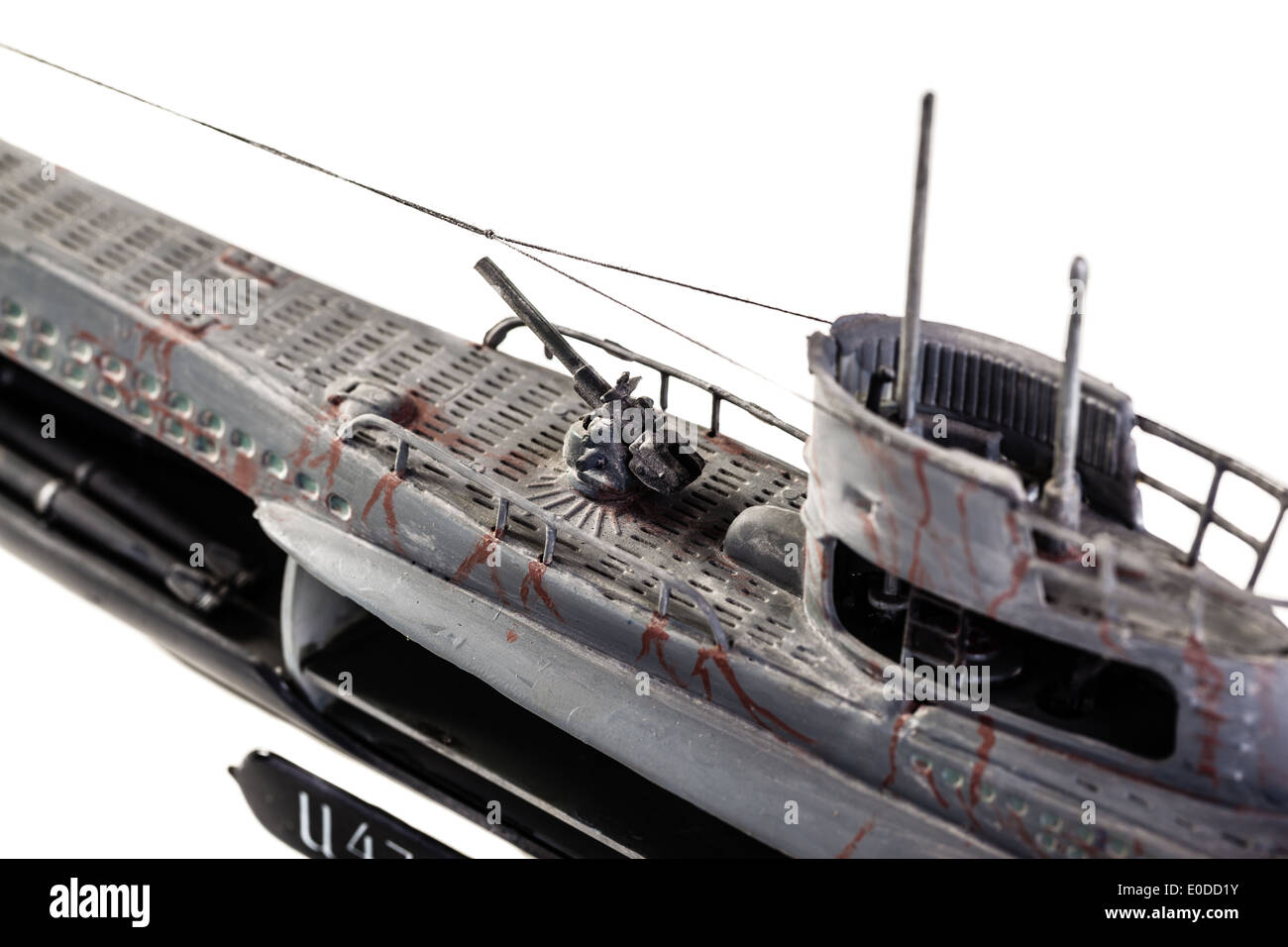
German submarine U-347 was a Type VIIC U-boat of Nazi Germany's Kriegsmarine during World War II.
She was a member of three wolfpacks.
She was on her fourth patrol when she was sunk by a British aircraft on 17 July 1944.
She sank or damaged no ships.
Design
German Type VIIC submarines were preceded by the shorter Type VIIB submarines. U-347 had a displacement of 769 tonnes (757 long tons) when at the surface and 871 tonnes (857 long tons) while submerged. She had a total length of 67.10 m (220 ft 2 in), a pressure hull length of 50.50 m (165 ft 8 in), a beam of 6.20 m (20 ft 4 in), a height of 9.60 m (31 ft 6 in), and a draught of 4.74 m (15 ft 7 in). The submarine was powered by two Germaniawerft F46 four-stroke, six-cylinder supercharged diesel engines producing a total of 2,800 to 3,200 metric horsepower (2,060 to 2,350 kW; 2,760 to 3,160 shp) for use while surfaced, two AEG GU 460/8–27 double-acting electric motors producing a total of 750 metric horsepower (550 kW; 740 shp) for use while submerged. She had two shafts and two 1.23 m (4 ft) propellers. The boat was capable of operating at depths of up to 230 metres (750 ft).
The submarine had a maximum surface speed of 17.7 knots (32.8 km/h; 20.4 mph) and a maximum submerged speed of 7.6 knots (14.1 km/h; 8.7 mph). When submerged, the boat could operate for 80 nautical miles (150 km; 92 mi) at 4 knots (7.4 km/h; 4.6 mph); when surfaced, she could travel 8,500 nautical miles (15,700 km; 9,800 mi) at 10 knots (19 km/h; 12 mph). U-347 was fitted with five 53.3 cm (21 in) torpedo tubes (four fitted at the bow and one at the stern), fourteen torpedoes, one 8.8 cm (3.46 in) SK C/35 naval gun, 220 rounds, and two twin 2 cm (0.79 in) C/30 anti-aircraft guns. The boat had a complement of between forty-four and sixty.
Service history
The submarine was laid down on 19 October 1942 at the Nordseewerke yard at Emden as yard number 219, launched on 21 May 1943 and commissioned on 7 July under the command of Oberleutnant zur See Johahn de Buhr.
U-347 served with the 8th U-boat Flotilla, for training and the 9th flotilla for operations from 1 March 1944. She was reassigned to the 11th flotilla on 1 June 1944.
First patrol
U-347 had sailed from Kiel in Germany to Stavanger in Norway March 1944, but her first patrol began when she departed Stavanger on 9 May. She arrived at Narvik on the 13th.
Second patrol
Her second foray began on 15 May 1944 when she departed Narvik (a port she would use as a base for the rest of her career), for the Norwegian Sea. She returned on 8 June.
Third patrol
U-347 departed Narvik on 23 June 1944; she returned the same day.
Fourth patrol and loss
The boat had departed Narvik on 3 July 1944. On the 17th, she was sunk by a B-24 Liberator of No. 86 Squadron RAF.
Forty-nine men died in the U-boat's sinking; there were no survivors.
Previously recorded fate
U-347 was thought to have been sunk on 17 July 1944 west of Narvik by a British PBY Catalina of No. 210 Squadron RAF. The pilot, Flying Officer John Cruickshank, was awarded the Victoria Cross for sinking U-361.
Wolfpacks
U-347 took part in three wolfpacks, namely:
- Trutz (15 – 31 May 1944)
- Grimm (31 May – 6 June 1944)
- Trutz (5 – 10 July 1944)
References
Bibliography
External links
- Helgason, Guðmundur. "The Type VIIC boat U-347". German U-boats of WWII – uboat.net. Retrieved 26 December 2014.
- Hofmann, Markus. "U 347". Deutsche U-Boote 1935–1945 – u-boot-archiv.de (in German). Retrieved 26 December 2014.